
Move over, Geneva. Step aside, New York. The real hub of international diplomacy recently took over Alice Smith as the entire Year 8 cohort stepped into the shoes of global diplomats for our highly anticipated COP2 Climate Summit.
It was an event filled with fiery debates, intense negotiations, and a level of critical thinking that could give actual world leaders a run for their money. Our brilliant, young Geographers didn't just learn about the future of our planet, they actively set out to rewrite it.
An Inspirational Spark from the Frontlines
The summit kicked off with an absolute masterclass in real-world inspiration. We were incredibly fortunate to be introduced by our amazing school alumna, Hyeinn Cecilia Roh.
Hyeinn Cecilia currently works directly for the United Nations in Yemen, focusing on frontline climate action. Speaking to the cohort, her keynote speech bridged the gap between classroom theory and global reality. She shared firsthand insights into her vital work with the UN, mapping out how local environmental crises tie directly into the UN’s Sustainable Development Goals (SDGs).
Hyeinn Cecelia’s call to action set a passionate tone for the day, leaving the students energised, inspired, and ready to debate. But the real-world expertise didn't stop there! The cohort also had the incredible privilege of hearing from Andrew Le Masurier, an environmental scientist from ITOPF (International Tanker Owners Pollution Federation), who brought the critical stakes of SDG 14 (Life Below Water) to life. Andrew captivated the room with accounts of his global career, but focused on his recent work looking at a complex oil spill in Kerala, India. Listening to Andrew's firsthand experiences gave our delegates a front-row seat into how environmental science, emergency response, and future fuel technologies intersect to protect our oceans on a global scale.
The Road to the Summit: Researching the Globe
Long before the opening gavel sounded, the groundwork for this summit was laid in Geography classrooms. Each class was assigned a specific country to represent, complete with an elected leader chosen to champion their nation’s interests on the global stage.
Students spent weeks diving deep into their assigned countries, uncovering a balanced, messy, and realistic picture of our world. They researched:
- How their country is being directly devastated by climate change.
- The negative impacts their country inflicts on the planet (carbon footprints, industrial emissions, deforestation).
- The positive strides and green initiatives their country is pioneering to protect the biosphere.
Armed with notes full of statistics, historical context, and economic data, our newly minted delegates walked into the summit room fully prepared to defend their borders and their ideals.
Inside the Room: House Alliances and Heated Debates
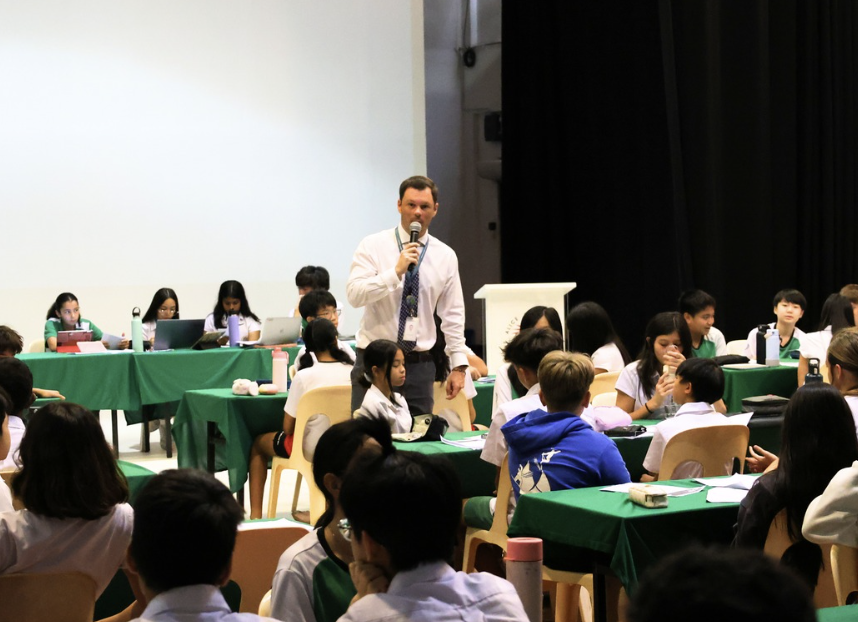
When the summit officially opened, the traditional classroom layout vanished. Tables were meticulously organised by School Houses, purposefully structured so that each table contained exactly one student from each represented 'country.'
The task? To collaborate, debate, and draft ambitious regional pledges addressing the planet's most critical vulnerabilities, specifically targeting SDG 14 (Life Below Water), SDG 15 (Life on Land), and SDG 5 (Gender Equality).
The room immediately transformed into a pressure cooker of international diplomacy. Delegates quickly realised that what is good for a heavily industrialised nation isn't necessarily what a low-lying island nation wants to hear. Compromises had to be forged, alliances were tested, and voices were raised in passionate defense of the environment.
The Pitch: Outstanding Knowledge on Display
Once the dust settled on the debate floor, table groups submitted their crafted pledges to our designated panel of 'world leaders.' The stakes were high where the leaders would vet the documents and select the top 3 pledges to move to the final round.
While the world leaders locked themselves away to deliberate, the rest of the cohort didn't waste a single second. The tables immediately pivoted into campaign mode, frantically co-writing high-stakes speeches. Every student worked to prepare a pitch so that, if their table's pledge was chosen, they were ready to take the microphone and convince the entire delegation why their solution was the absolute best.
When the top pledges were announced, the resulting pitches were nothing short of spectacular. Standing before the entire cohort, the speakers displayed outstanding knowledge about climate action. They seamlessly woven together advanced concepts from their term-long Geography lessons with the fresh data gathered during their pre-summit research. The eloquence, confidence, and scientific accuracy on display left the teachers in awe.
The Winning Frameworks
After the pitches concluded, democratic power was handed right back to the students. The entire cohort casted their votes to determine which masterfully designed pledges would become the official frameworks for the event.
The COP2 summit made me realise that the problems caused by climate change will ultimately be ours, part of a world that we will inherit. Simulating a real COP summit made me realise that the ideas we have now will eventually be the ones that spark real change as the job of saving the planet will fall to us. ~ Ira, Year 8
The summit focused on generating two distinct manifestos: the first targeting environmental ecosystems, and the second tackling the human element of climate justice.
Pledge 1 (SDG 14 & 15: Oceans & Land) – Won by Fleming House
Fleming House clinched the victory with a sophisticated, highly detailed economic and environmental tax model that stunned the room with its macro-level maturity.
The Fleming Accord: All UN members will implement a population and corporate tax scaled directly to carbon emissions relative to a nation's GDP. Heavily polluting companies and wealthier nations will bear a significantly higher tax burden, while nations relying on or expanding renewable energy will see their taxes drastically reduced. 100% of these collected funds will be funnelled into a strictly non-profit, designated specialist team within the UN. This team will entirely redistribute the capital worldwide to fund renewable energy infrastructure, ensuring green technology and vital resource wealth are spread equitably to developing countries that need it most.
Pledge 2 (SDG 5: Gender Equality) – Won by Muir House
The second vote shifted focus to the disproportionate impact climate change has on women and girls globally, particularly in developing agricultural regions. Muir House walked away with a brilliant, forward-thinking victory focused on systemic institutional change.
The Muir Resolution: Recognising that women are frequently on the frontlines of ecological changes, this pledge mandates a legally targeted framework to increase the global number of women working in scientific research and environmental leadership roles by a minimum of 10% by the year 2040. This historic shift will be systematically achieved through fully funded, grassroots climate and STEM education programs specifically tailored for young women within primary and secondary schools worldwide.
Gavel Down on a Phenomenal Success
As the high-stakes voting concluded, Year 12 students Chantal and Illyas took to the stage to bring the momentous event to a close. Delivering the final closing remarks, they perfectly summarised the electric atmosphere of the day, celebrating the immense dedication, maturity, and academic brilliance of our Year 8 Geographers.
The COP2 Climate Summit proved that our students aren't just passive observers of global issues, they are active, articulate problem-solvers ready to inherit and fix the world. A massive congratulations to all of Year 8, our winning houses, and the Geography department for organising an unforgettable day of Geography in Action.