
School trips are an important part of a child’s education. They provide opportunities to explore new places, develop independence, experience different cultures and apply classroom learning in real-world settings. But with many educational trips involving air travel, schools also have a responsibility to consider their environmental impact.
At Alice Smith School, our students have started a campaign and have been exploring an important question: Can school travel be climate-responsible?
Their investigation into the carbon emissions generated by educational trips has developed into a powerful example of student-led climate action, allowing students to apply their learning to a real-world challenge and influence decisions within our school community.
Measuring the carbon impact of school trips
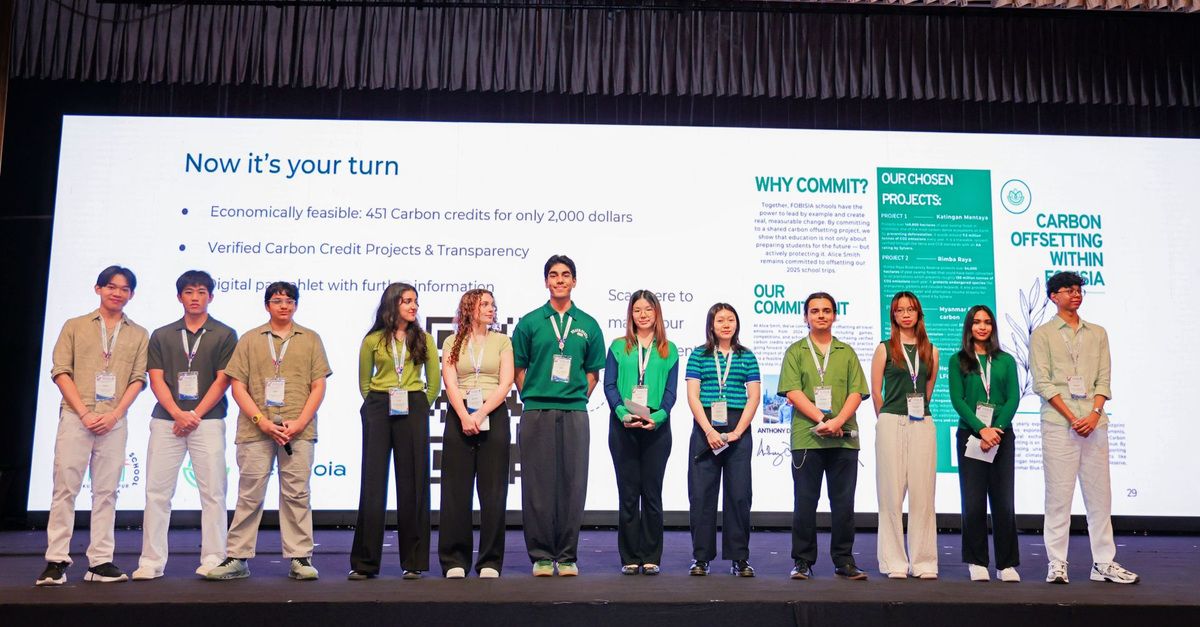
The project began when 12 of our A-Level students were invited to investigate the environmental impact of travel to the 2025 FOBISIA Leadership Conference.
Their analysis estimated that travel to the conference generated 451 tonnes of carbon dioxide equivalent (tCO2e). Rather than stopping at measuring the emissions, the students explored what could be done to take greater responsibility for the environmental impact of travel.
They researched different carbon offsetting projects, examined project information and independent assessments, and evaluated the strengths and limitations of different approaches.
Students then presented their recommendations to around 400 school leaders at the Conference.
FOBISIA subsequently accepted their recommendations and purchased carbon credits from four projects, with a total cost of USD 1,860.
For the students, this was a valuable lesson in environmental education and climate literacy. They were working with real data, evaluating evidence and communicating their findings to education leaders – skills that extend far beyond the classroom.
From student investigation to school-wide action
Inspired by their experience, they brought their findings back to Alice Smith and challenged school leaders to consider the carbon impact of our own educational travel.
This led to important conversations about whether and how a school should address emissions from school trips.
Carbon offsetting is a complex and contested area, and school leaders had legitimate questions about the credibility of carbon credits. Could projects deliver the environmental benefits they claimed? How could the school minimise the risk of greenwashing, double-counting, and weak project outcomes? And how could we ensure that our approach was both responsible and transparent?
Students responded by diving deeper into the research. They examined project documentation, analysed data from independent ratings and compared competing claims. Importantly, they recognised that there are no simple answers and were transparent about the limitations and uncertainties associated with carbon offsetting.
Cost was another consideration. Instead of proposing an open-ended commitment, the students recommended beginning with Trips Week and an offsetting project they had researched and assessed, using the existing Enrichment budget.
By responding to these valid concerns with thorough evidence and research, the students turned an ambitious idea into a realistic approach that the school was able to adopt.
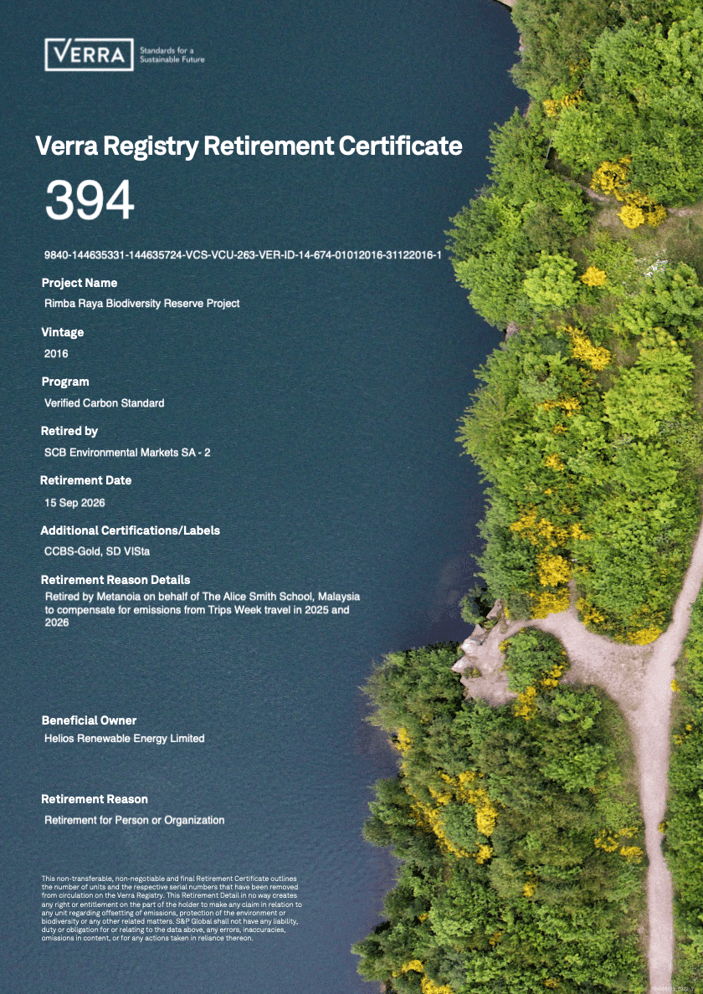
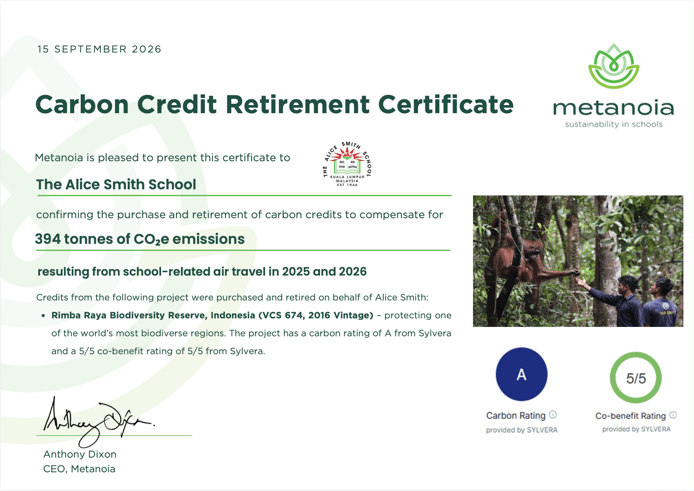
As a result, Alice Smith has offset 394 tCO2e from our 2025 and 2026 Trips Weeks, by retiring the equivalent carbon credits generated by the Rimba Raya Biodiversity Reserve in Indonesia. This means that based on our calculated travel emissions, Trips Week travel for the past two years has been carbon neutral.
Developing real-world skills through climate action
The impact of this project goes beyond the carbon emissions addressed.
By taking part in the investigation, our students developed practical skills in data analysis, research, critical thinking, financial decision-making, collaboration and communication.
They also learned how to navigate a complex issue where there is not always one clear answer.
Most importantly, they experienced the impact of using their learning to influence a real decision. Their research was not simply an assignment that ended when it was marked. It contributed to a conversation about how our school approaches sustainable school travel, and this conversation remains ongoing.
This is a powerful example of learning in action: students identifying a problem, gathering evidence, challenging assumptions, presenting recommendations and helping shape change.
Looking beyond carbon offsetting
Our students also recognised an important principle: carbon offsetting is not a silver bullet for school travel emissions.
Addressing the climate impact of educational trips requires a broader approach. Schools should first consider whether travel is essential, then explore ways to reduce emissions – including alternative forms of transport where practical – before considering how to address unavoidable emissions.
For Alice Smith, this means continuing to examine how we can make our educational travel more climate-responsible while preserving the transformative experiences that school trips provide.
Looking ahead, we aim to encompass all global curriculum excursions within this approach and further embed climate-responsible travel principles into school policy.
Inspiring climate action across schools
What started as a student investigation has now grown into a wider initiative.
Together with The Alliance for Sustainable Schools and Metanoia, the experience at Alice Smith has helped inspire the Climate-Responsible Travel for Schools Campaign. The campaign aims to address 50,000 tonnes of school trip emissions across 100 schools by June 2027.
Other schools are already taking action. Marlborough College Malaysia and Amnuay Silpa School have begun addressing emissions from school trips, while Chinese International School in Hong Kong has addressed 1,050 tCO2e from a full year of travel.
We hope more schools will join this growing movement and involve their students in understanding and addressing the environmental impact of educational travel.
Empowering students to shape a better future
At Alice Smith, we believe education should empower children to understand the world around them and have the courage to help shape its future.
Our students’ work on climate-responsible school travel demonstrates what can happen when learning connects with meaningful action. By making the carbon impact of travel visible, they have started important conversations, developed valuable real-world skills and influenced decisions within their own school community.
School trips will continue to play an important role in education. But by measuring our impact, exploring ways to reduce emissions and making thoughtful decisions about what remains, we can take meaningful steps towards more sustainable school travel.
For our students, the most important lesson may be that creating positive change does not always begin with having all the answers. Sometimes, it begins with asking the right questions.