

By Benedict John, Year 11 Leader
As the school holidays approach, many parents wonder how to help their teenagers balance rest, wellbeing and preparation for the January 2026 mock exams. The good news? With the right strategies, teens sitting GCSEs can revise effectively in just 2-4 hours a day, while still enjoying time with friends, family, and festive activities. The key is efficiency, using active revision techniques that maximise output while protecting motivation and mental health.
This blog brings together wellbeing foundations, a balanced holiday routine, and proven revision techniques.
Key Wellbeing Foundations
Prioritise sleep: 8-10 hours nightly is recommended. Encourage basics like eating healthy, exercising, sleeping well, keeping things simple and thinking positively to counter risks.
Watch for excessive social media use: Heavy use frequently delays bedtimes, as *46% of teens report near-constant online presence, prioritising scrolling over wind-down routines (* Teens, social media and technology). Blue light from screens suppresses melatonin, fragmenting sleep cycles and contributing to the gap between recommended 8-10 hours and actual averages below 7 for many.
Encourage your teen to:
- Keep devices out of the bedroom at night
- Establish wind-down routines
- Eat well, stay active and maintain simple, positive habits
A well-rested brain learns faster, makes stronger memories and avoids burnout.
Active Revision Techniques
Arguably the most powerful technique, students retrieve information from memory rather than passively re-reading. Incorporate these evidence-based methods for the 172 holiday days (13th November - 4th May 2026) in a year:
- Flashcards with spaced repetition - Flashcards reviewed after 1, 3, and 7 days are far more effective than cramming.
- Summarising notes into short bullet points, diagrams, or Cornell notes helps cement key ideas.
- Revising material at increasing intervals boosts long-term retention.
- Dual coding (visuals + words), self-questioning from notes/textbooks and physical movement during review.
- Pomodoro technique - 25 minutes focused study + 5 minutes break. Helps maintain momentum without fatigue.
- Voice notes/podcasts, YouTube, followed by active tasks like flashcards or summaries.
- Highlighting and annotating - Useful when paired with active tasks such as summarising highlighted sections.
- Mnemonics and Acronyms : Mnemonics involve using acronyms, rhymes, or associations to help students memorise key facts, lists and complex information effectively.
Remembering the order of operations in mathematics through the acronym “BODMAS” (Brackets, Orders, Division, Multiplication, Addition, Subtraction)
In chemistry, students may use OIL RIG (Oxidation Is Loss, Reduction Is Gain) to remember redox reactions.
For testing retention:
- Brain dumps (add gaps in new colour) - Write everything you know about a topic, then fill gaps in a different colour.
- Past papers and exam technique - Practising timed answers builds confidence and familiarises students with mark schemes.
- Teach someone else (Feynman technique) - Explaining a topic clearly to another person reveals gaps and strengthens understanding.
- Mind maps with gap-filling, active recall ("give me 5"), timed past papers, building from topics to full mocks. Ideal for visual thinkers, mind maps show how concepts connect - great for subjects like Science, Geography, and History.
Sample Holiday Schedule for a GCSE student
Model a balanced week, like this excerpt, allocating ~1 hour daily across subjects (Maths, Geography, Science, etc.), with lunches, downtime, sports, and evenings off:
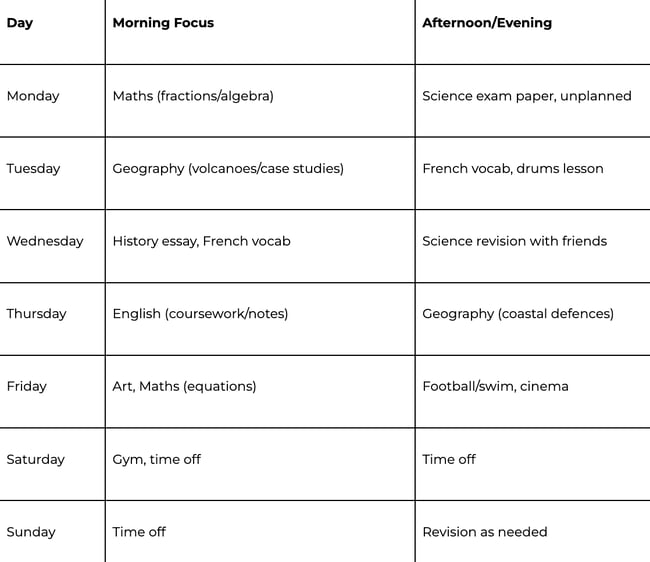
Total: 15-120+ minutes daily scales to 43-344 hours over holidays (1.8-14.3 days equivalent).
Mock Exam Preparation Tips
Students should:
- Attend all January 2026 mock days - make sure you have the equipment you need and are dressed appropriately
- Arrive 20 minutes early, even on days without exams—to revise with peers, ask teachers, and build focus. These simulate real conditions, reducing future stress
- Pair with a family-agreed holiday plan prioritising wellbeing over endless study
- Develop a personal study timetable
- Make sure revision is active, and it is efficient
Most importantly, remind your teen that revision should be active, efficient, and sustainable. Small, consistent daily habits outperform marathon cramming sessions every time. By incorporating a variety of these revision techniques, students can find the methods that work best for them, leading to more effective study sessions and better retention of material and ultimately perform better in their exams. Each student may benefit from different methods, so it’s important to experiment and find what works best for individual learning styles.
*Students can experiment with and select which apps support their way of learning.
- Brainstorming: SimpleMind, Ideament, iMindmap, Mindnote, Spiderscribe
- Collaborating: Bubblus, GoConqr, Coggle
- Organising: myHomework, Exam countdown
- Revision note-taking: Evernote, Audiomemos Free, Voice Recorder, Making a cartoon strip, Creating a Revision Avatar, Infographics, Anki
- Using video: Making a revision video
- Revision: Gojimo, ExamCountdown, Getrevising, Seneca, Physicsandmathstutor*, Yacapaca
* = this includes Biology, Chemistry, Geography, Economics and Psychology - Relaxation: Headspace, Insight Timer
- Workshop slides presented by Ben John https://alice-smith.myschoolportal.co.uk/view/document/302